April 10, 1970
Northwest Passage (1940) ***
Curious film, set in 1759, about British North American soldiers raiding an Indian village in French Canada and exterminating all its inhabitants.

Nobuko (1940) ***

Second Chorus (1940) ***
This low-key, unpretentious musical has been grossly underrated by critics and film-goers alike. It stars Fred Astaire and Burgess Meredith as two jazz musicians in love with the same girl (Paulette Goddard). Musical numbers include:
"Sugar" *
"Everything's Jumping" *
"Dig It" **
"Sweet Sue" **
"Would You Like To Be The Love Of My Life" **
"Poor Mr. Chisholm" (song) *
"Concerto For Clarinet" **
"Poor Mr. Chisholm / Hoe Down The Bayou" **
"Sugar" *
"Everything's Jumping" *
"Dig It" **
"Sweet Sue" **
"Would You Like To Be The Love Of My Life" **
"Poor Mr. Chisholm" (song) *
"Concerto For Clarinet" **
"Poor Mr. Chisholm / Hoe Down The Bayou" **
Road To Singapore (1940) **


Dr Ehrlich's Magic Bullet (1940) **
Another bio-medico-pic in the tradition of "The Story Of Louis Pasteur".
All This And Heaven Too (1940) *
Dated, but effective melodrama starring Bette Davis as a governess implicated in a huge scandal.
Timur And His Team (1940) *
Very disappointing Soviet film based upon a popular novel by Arkadi Gajdar.
Dance Girl Dance (1940) *
While it has a few musical numbers, it's not really a musical, but rather an anti-musical, as it subverts the main themes of the Hollywood musical, delivering instead a vaguely feminist melodrama where musical and romantic ambitions mutually sabotage themselves.
Quicker'n A Wink (1940) ***
Oscar-nominated novelty short using different camera speeds to show various objects in motion.
Power And The Land (1940) ***

London Can Take It (1940) ***


Siege (1940) ***


Broadway Melody Of 1940 (1940) ***
The third and probably the best of Eleonor Powell's "Broadway" musical extravaganzas. This time, Fred Astaire replaces Robert Taylor and the result is the teaming of two greatest tap dancers in Hollywood history. Numbers include:
"Please Don't Monkey With Broadway" **
"All Ashore"
"Between You And Me" *
"I've Got My Eyes On You" **
"Jukebox Dance" **
"I Concentrate On You" **
"Begin The Beguine" ***
"Please Don't Monkey With Broadway" **
"All Ashore"
"Between You And Me" *
"I've Got My Eyes On You" **
"Jukebox Dance" **
"I Concentrate On You" **
"Begin The Beguine" ***

Down Argentine Way (1940) ***
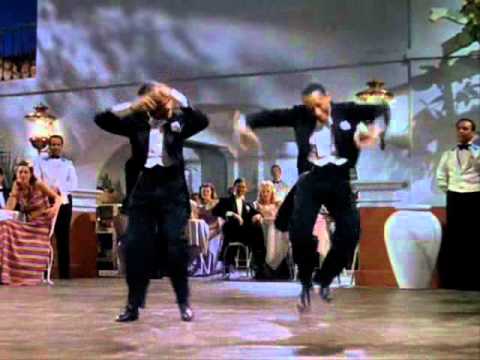
"South American Way" **
"Down Argentine Way" (song) ***
"Two Dreams Met" *
"Down Argentine Way" (dance) ***
"Nenita" *
"Doin' The Conga" *
"Mama Yo Quiero" **
"Bambu" *
"Sing To Your Senorita" **
"Two Hearts Met" (reprise) *
Rebecca (1940) ***
 Interesting adaptation of a Daphne du Maurier's novel about a young girl married to an English aristocrat whose first wife had died under mysterious circumstances.
Dr Cyclops (1940) ***
Excellent special effects highlight this interesting film that mixes several genres: adventure, horror and science-fiction.
Foreign Correspondent (1940) ***
Alfred Hitchcock's thriller set in Holland shortly before the Nazi invasion.
Abe Lincoln In Illinois (1940) ***
 An example of pure Americana, the story of Abraham Lincoln's adult life before he became president.
Go West (1940) ***
Along with "A Night in Casablanca" (1946), this is Marx Brothers' most enjoyable film since "A Day at the Races" (1937). Harpo is in a particularly great form here, especially during the justly celebrated "train ride" sequence.

The Great Dictator (1940) ***

The Thief Of Bagdad (1940) ****
 Colorful fantasy film based on "Arabian Nights" tales. It's not a remake of the 1924 Douglas Fairbank's film. The plot is completely different. Directors: Michael Powell and Tim Whelan. Ludwig Berger is listed as a co-director, but the black and white footage he shot was never included in the film.
It's A Date (1940) ***

"Love Is All" **
"Loch Lomond" **
"Rhythm Of The Islands" *
"Quando M'en Vo (Musetta's Waltz)" **
"Ave Maria" **
Pride And Prejudice (1940) ****
 An excellent adaptation of Jane Austen's most popular novel. A superb comedy of manners.
Kitty Foyle (1940) ***
Ginger Rogers won an Oscar for her fine performance as a poor young girl who marries a very rich man.
The Philadelphia Story (1940) ****
 Katherine Hepburn plays a rich Philadelphia woman, who must choose between three men: her new fiancee, her former husband (Cary Grant) and a young reporter (James Stewart).
Little Nellie Kelly (1940) ***
Judy Garland, Charles Winninger and George Murphy star in this film adaptation of George M.Cohen's play about an Irish immigrant family in New York. Songs include:
"It's A Great Day For The Irish" *
"A Pretty Girl Milking Her Cow" *
"Singin' In The Rain" **
"Nellie Kelly I Love You" **
"It's A Great Day For The Irish" *
"A Pretty Girl Milking Her Cow" *
"Singin' In The Rain" **
"Nellie Kelly I Love You" **

My Favorite Wife (1940) ***
A woman returns from a desert island to find her husband engaged to another woman.
Pinocchio (1940) *****
 One of the greatest animated films ever made, a superb adaptation of Carlo Collodi's children classic. The film, whose incredibly realistic animation would remain unsurpassed for more than half a century, is memorable for its conceptions of individual characters (imposing Stromboli, cunning Honest John, stupid Gideon, wise Jiminy Cricket, terrifying Monstro the Whale and many others). Superb songs include:
"When You Wish Upon A Star" ***
"Little Woodenhead" **
"Give A Little Whistle" *
"Hi Deedle Dee Dee" **
"I've Got No Strings" **
His Girl Friday (1940) *****
 One of the best (and fastest) comedies of all times. Superb dialogues, delivered at the speed of light.
New Moon (1940) ***
Nelson Eddy is a French aristocrat who leads a revolt of prisoners in New Orleans. Jeanette McDonald is a French aristocrat whose ship is captured by those prisoners. They all find themselves on a tropical island and live happily ever after. Songs:
"Dance Your Cares Away" *
"The Way They Do It In Paris" *
"Shoes" *
"One Kiss" *
"Wanting You" ***
"Lover Come Back To Me" *
"Stout-Hearted Men" **
"Marianne" *
"Lover Come Back To Me" (reprise) **
"Dance Your Cares Away" *
"The Way They Do It In Paris" *
"Shoes" *
"One Kiss" *
"Wanting You" ***
"Lover Come Back To Me" *
"Stout-Hearted Men" **
"Marianne" *
"Lover Come Back To Me" (reprise) **
Service With The Colors (1940) **
The difficulties of adapting to the Army's life are explored in this Oscar-nominated short.
The Shop Around The Corner (1940) ***
Two pen pals work in the same shop. Surprisingly modern comedy - it could have been set in our Internet world without changing a single line of dialogue.
Strike Up The Band (1940) ***

"Our Love Affair" **
"Do The Conga" **
"Nobody" **
"Nell Of New York" *
"Drummer Boy" ***
"Strike Up The Band" **
Tin Pan Alley (1940) ***
Excellent musical starring Alice Faye and Betty Grable. Songs include:
"Hawaii, Lovely Hawaii" **
"You Say The Sweetest Things, Baby" ***
"Moonlight Bay" ***
"Honeysuckle Rose" **
"Moonlight And Roses"
"America I Love You" *
"Goodbye Broadway Hello France" *
"The Sheik Of Araby" **
"K-K-K-Katy" *
The video version also includes a song that was deleted from the film:
"Get Out And Get Under" **
"Hawaii, Lovely Hawaii" **
"You Say The Sweetest Things, Baby" ***
"Moonlight Bay" ***
"Honeysuckle Rose" **
"Moonlight And Roses"
"America I Love You" *
"Goodbye Broadway Hello France" *
"The Sheik Of Araby" **
"K-K-K-Katy" *
The video version also includes a song that was deleted from the film:
"Get Out And Get Under" **
The House Of Seven Gables (1940) **
An adaptation of Nathaniel Hawthorne's novel about a tragic hatred between two brothers. **
Our Town (1940) **
Often dreary, occasionally uplifting film about life in a small New England town at the turn of the century. There are some brechtian devices, with a narrator talking directly to the audience and sometimes inviting other characters to do likewise. **
Santa Fe Trail (1940) **
The most reactionary Hollywood film since "The Birth Of A Nation" (1915). Its villains are abolishionists led by John Brown, who fought against slavery in 1850's.
Too Many Girls (1940) *
Four college football players are hired as bodyguards for a rich heiress (Lucille Ball). Mediocre musical with a weak score by Richard Rogers and Lorenz Hart. Songs:
"Heroes In The Fall" *
"You're Nearer" *
"Pottawatomie" *
"'Cause We All Got Cake" *
"Spic And Spanish" *
"Love Never Went To College" *
"Look Out" *
"I Didn't Know What Time It Was" *
"You're Nearer" (reprise) *
"Heroes In The Fall" *
"You're Nearer" *
"Pottawatomie" *
"'Cause We All Got Cake" *
"Spic And Spanish" *
"Love Never Went To College" *
"Look Out" *
"I Didn't Know What Time It Was" *
"You're Nearer" (reprise) *
The Eternal Jew (1940) ***
The infamous Nazi documentary that paved the way to the Holocaust. Creepy and terrifying, a work of pure evil.
Crimes At The Dark House (1940) **
Tod Slaughter stars as a Australian mass-murderer pretending to be an inheritor of a British estate.
L'il Abner (1940) *
Silent greats Buster Keaton (Lonesome Polecat), Edgar Kennedy (Cornelius Cornpone), Chester Conklin (Mayor Gurgle) and Al St. John (Joe Smithpan) appear in this otherwise mediocre adaptation of Al Capp's immortal comic strip about those zany barefoot hillbillies from Dogpatch, Arkansas. Not nearly as good as the 1959's musical version.
Jew Suss (1940) ****

A Wild Hare (1940) *****

You Ought To Be In Pictures (1940) ****

Musical Poster #1 (1940) ****
Abstract patterns fill the screen while jazz music is playing on the soundtrack. It's followed by a propaganda message calling for vigilance against Nazi spies. British film directed by Len Lye.
Window Cleaners (1940) ****

Puss Gets The Boot (1940) ****

A Rainy Day (1940) ****


Knock Knock (1940) ****

Cross Country Detours (1940) ****

Bone Trouble (1940) ****

The Bear's Tale (1940) ****

The Milky Way (1940) ***
Disneyesque MGM cartoon about three kittens discovering the Milky Way. Nominated for an Academy Award.
The Lonesome Stranger (1940) ***
Hugh Harman's MGM cartoon set in the Far West, where a masked hero defeats a gang of outlaws. A clear indication of the growing influence of the High Warner screwball cartoon style.
Tugboat Mickey (1940) ***
Mickey, Donald and Goofy respond to a false distress signal at sea and their tugboat is sunk. The last "trio" Disney cartoon.
The Riveter (1940) ***
Donald finds a job as a construction worker, but he suffers from vertigo and is unable to handle his equipment properly. Amusing and very well animated.
Porky's Hired Hand (1940) ***
Farmer Porky hires a lazy and stupid helper to protect his chickens from a smart fox.


Mr Mouse Takes A Trip (1940) ***
Mickey and Pluto have some troubles with a conductor, who insists that dogs are not allowed on trains (but apparently mice are fine). A typical Disney effort.
Good Night Elmer (1940) ***
Elmer tries to sleep, but a candle insists on burning all night and there is just no way to extinguish its flame. One of very few Elmer's solo cartoons. In their book "Looney Tunes and Merrie Melodies", Jerry Beck and Will Friedwald called it "one of the most irritating cartoons ever made". One must strongly disagree with that opinion. Director Chuck Jones was clearly conducting an experiment here, trying to squeeze as much humor as possible from a simple and ordinary premise. This film might have even inspired Disney's "Drip Dippy Donald" (1948).
Subscribe to:
Posts (Atom)