March 10, 1970
The Big House (1930) ***
The granddaddy of all prison pictures, and still the most extreme one, with army tanks putting down a prison riot.

Walk Cheerfully (1930) ***
Ozu's gangster film about a small-time hood who wants to go straight for a good girl. Screenplay by Tadao Ikeda, based on a story by Hiroshi Shimizu.
Paramount On Parade (1930) ***
An all-star musical revue. Highlights include: George Bancroft attending the same party twice, Maurice Chevalier quarreling with Evelyn Brent, Mitzi Mayfair dancing "I'M In Training For You" and little Mitzi Green singing an encore of "All I Want Is Just One Girl". Several musical numbers are missing their soundtracks ("I'M Isadore The Toreador", "Nichavo" and "Let's Drink To The Girl Of My Dreams"; the last one directed by Edmund Goulding). Ernst Lubitsch directed all three Maurice Chevalier segments. Musical numbers:
"We're The Masters Of Ceremony" *
"Anytime's The Time To Fall In Love" **
"Come Back To Sorrento" **
"I'M In Training For You" **
"My Marine" *
"All I Want Is Just One Girl" **
"What Did Cleopatra Say ?" *
"Dancing To Save Your Sole" *
"I'M True To The Navy Now" *
"Sweeping The Clouds Away" **
"We're The Masters Of Ceremony" *
"Anytime's The Time To Fall In Love" **
"Come Back To Sorrento" **
"I'M In Training For You" **
"My Marine" *
"All I Want Is Just One Girl" **
"What Did Cleopatra Say ?" *
"Dancing To Save Your Sole" *
"I'M True To The Navy Now" *
"Sweeping The Clouds Away" **
I Flunked But (1930) ***


=443221476_cain-4.jpg)


Free And Easy (1930) ***

"It Must Be You" **
"Free And Easy" **
"It Must Be You" (reprise) *


Min And Bill (1930) ***
Marie Dressler won a well-deserved Academy Award for Best Actress for her superlative performance as a tough saloon owner who tries to protect her adopted daughter from her evil biological mother. Wallace Beery is equally good as her best friend.

Na Sybir (1930) ***
 Patriotic drama about a Polish freedom fighter deported to Siberia. Set in 1905. Directed by Henryk Szaro ("Mocny czlowiek").


The Big Trail (1930) ***

The Devil's Holiday (1930) **
Old-fashioned, dated and uneven melodrama about a gold digger marrying a rich kid for his dough, but ending falling with love with him anyway. The ultimate “gold digger with a heart of gold” melodrama.
Raffles (1930) **
Entertaining, if unexceptional film starring Ronald Coleman as a suave jewel thief.
Sarah And Son (1930) *
Dorothy Arzner directed this dated melodrama about an opera singer looking for her lost son.
What Made Her Do It? (1930) *
Simplistic, but visually impressive, Japanese social drama about a poor waif persecuted by one-dimensional villains.

The Big Pond (1930) *


Romance sentimentale (1930) ***

Another Fine Mess (1930) ***

Night Owls (1930) ***

Meet The Boyfriend (1930) ***




Laughing Gravy (1930) ***

Monte Carlo (1930) ***
 A young countess (Jeanette MacDonald) runs away from her own wedding and tries to win a fortune in Monte Carlo. Songs:
"Day Of Days"
"She'll Love Me And Like It"
"Beyond The Blue Horizon" **
"Give Me a Moment Please" **
"Trimmin' The Women" **
"Whatever It Is, It's Grand" *
"Always In All Ways" **
"Monsieur Beaucaire" *
"Beyond The Blue Horizon" (reprise) *
Bear Shooters (1930) **
Directed by Robert McGowan and produced by Hal Roach. The "Our Gang" kids go on a picnic.
The Golf Specialist (1930) **
Directed by M.Brice and produced by RKO. W.C.Fields is a guest in a Florida hotel, stealing piggybanks from little girls, flirting with young women and trying to play golf.
Office Blues (1930) **
Ginger Rogers plays a secretary in love with her boss. Plenty of songs. Directed by Mort Blumenstock, Produced by Paramount.
The Laurel & Hardy Murder Case (1930) *
Stan and Ollie want to claim an inheritance, but they are suspected of murder instead. A rather trite parody of the murder-mystery film.
Hell's Angels (1930) ***

L'Age d'or (1930) *****

Animal Crackers (1930) ****
 There are three types of Marx Brothers' fans - those who most admire their first two movies, filmed in Paramount's Astoria studios on Long Island; those who especially like their Hollywood films produced by Paramount in the early 30's; and finally those (including Groucho himself) who prefer their early MGM films produced by Irving Thalberg. The MGM films are handsomely produced, have plenty of gags and there no stiff Zeppo to drag them down. However, Harpo's anarchic humor is toned down and there are fewer surrealistic touches. Their Paramount/Hollywood films are hilarious and exciting, but except for "Duck Soup" (1933), none of them is better than "Animal Crackers", an Astoria production that presents Marx Brothers at their very best. Two good (and very different) songs by Bert Kalmar and Harry Ruby:
"Hooray For Captain Spaulding" **
"Why Am I So Romantic ?" **
King Of Jazz (1930) ****
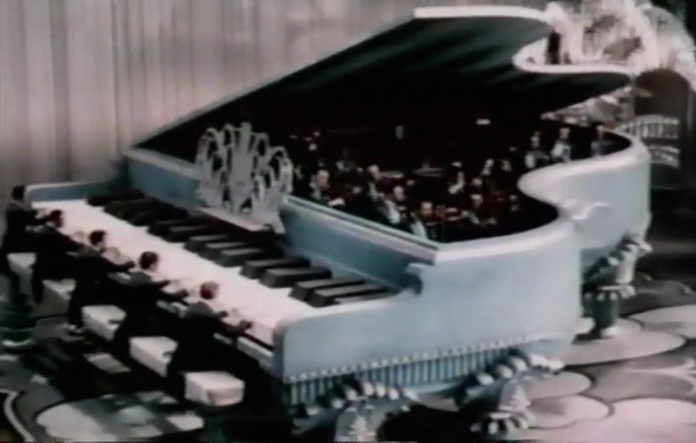

 The best of many all-talking, all-singing and all-dancing musical extravaganzas, made by the major Hollywood studios at the dawn of the sound era. This film, produced by Universal and superbly directed by John Murray Anderson, has a dozen of great musical numbers, as well as many funny sketches and a cartoon sequence by Walter Lantz. A masterpiece among the early Hollywood musicals, it had a great influence on many later films. Musical numbers:
"Bridal Veil" *
"So The Bluebirds And The Blackbirds Got Together" **
"It Happened In Monterey" **
"Oh, How I'D Like To Own A Fishstore"
"A Bench In The Park" **
"Rhapsody In Blue" ***
"Ragamuffin Romeo" **
"Happy Feet" ***
"I'D Like To Do Things For You" *
"Has Anybody Seen Our Nelly" *
"The Song Of The Dawn" *
"The Melting Pot Of Jazz" **
The Blue Angel (1930) ***
 A college professor (Emil Jennings) falls in love with a vain, manipulative and worthless cabaret performer (Marlene Dietrich in a star-making performance).
Feet First (1930) ***
 It's an uneven film - the first half is weak, but the movie redeems itself with a brilliant building climb sequence near the end.
Just Imagine (1930) ***
Enjoyably ridiculous science-fiction/musical with amazing set designs (clearly inspired by "Metropolis"). It also has trite dialogues, unpredictable story, bargain-basement songs, incompetent acting and mind-boggling costumes - all key ingredients of a memorable camp classic. Musical numbers include:
"There's Something About An Old-Fashioned Girl" *
"I'M The Words, You're The Melody"
"Drinking Song"
"Never Swat A Fly" *
"There's Something About An Old-Fashioned Girl" *
"I'M The Words, You're The Melody"
"Drinking Song"
"Never Swat A Fly" *
Morocco (1930) ***
 Marlene Dietrich followed her triumph in "The Blue Angel" with this exotic melodrama about a cabaret singer who falls in love with a foreign legionnaire (Gary Cooper). A triumph of cinematography and art direction.
Le Sang d'un poète (1930) ***

 An artist finds a statue which transforms itself into a muse and allows him to discover his own subconsciousness. Jean Cocteau's film debut illustrates a theme that an artist is a prisoner of his own genius and that his attempts to liberate himself are self-destructive.
Whoopee (1930) ***


"Cowboy Number" ***
"I'll Still Belong To You"
"Making Whoopee" ***
"A Girlfriend Of A Boyfriend Of Mine" *
"My Baby Just Cares For Me" ***
"Stetson" **
"I'll Still Belong To You" (reprise)
"The Song Of The Setting Sun" ***
"My Baby Just Cares For Me" (reprise) *
The Divorcee (1930) *
Norma Shearer won an Oscar for her performance in this curious film about marital infidelities and divorce. Daringly ahead of its time in 1930, the picture seems dated and old-fashioned today.
Half Shot At Sunrise (1930) *
Bert Wheeler and Robert Woolsey play American soldiers in Paris in 1918.
Salt For Svanetia (1930) *
Very boring documentary about a remote region of the Caucasus. Later, director Mikhail Kalatozov would move on to better and more exciting films (like "The Cranes Are Flying" and "I Am Cuba"). Running time: 53 min.
Storm Over Mont Blanc (1930) ***

The Cactus Kid (1930) ****

Winter (1930) ****

Sinkin' In The Bathtub (1930) ****

Monkey Melodies (1930) ***
Not much of a plot, but plenty of singing, dancing and swinging from trees in this pleasant Silly Symphony set in the African jungle. Best bit: a pair of tap-dancing gators.
The Fire Fighters (1930) ***
Mickey Mouse, Horace Horsecollar and the rest of the gang are brave firefighters, rescuing Minnie from a burning building. Surprising and inventive cartoon.
Dizzy Dishes (1930) ***


Subscribe to:
Posts (Atom)